
Anyone trying a copper peptide for the first time should patch-test on a small area before broader application. This effect has not been characterized in controlled clinical trials and is not formally documented in peer-reviewed literature. A 2024 study in Bioactive Materials (Liu et al.) using an ionic-liquid microemulsion delivery system reported that GHK-Cu accelerated the anagen (growth) phase in mice, comparable to or faster than 5% minoxidil in that model. When a cosmetic product simply says ‘copper peptide’ without specifying — it most often means GHK-Cu, listed under the cosmetic ingredient name Copper Tripeptide-1. GHK-Cu is the most studied member of the copper-peptide family, but it is not the only one.
GHK-Cu is frequently discussed as a “repair and remodeling” peptide, which is why it is often considered alongside, not instead of — peptides that drive growth-hormone signaling, gut/tendon repair, or metabolic goals. Over a 30-day on-cycle at 1–2 mg/day (the copper adds up), which is precisely why the field standardized on cycling and dose restraint rather than open-ended daily use. That is reassuring for a single dose, but the operative word is cumulative. This is the real reason cycling (dose restraint), and provider supervision matter.
A summary of the research, not medical advice. A copper binding tripeptide widely studied in skin, wound and regeneration research. Higher concentrations may increase results but also increase irritation risk. Current evidence supports excellent safety for long-term use with appropriate cycling.
Topical use at 0.05% to 2% is the established route; injection is explored only in research and is not standardized. This article reports published and user-reported figures for education. There is no approved or trial-established GHK-Cu dose.
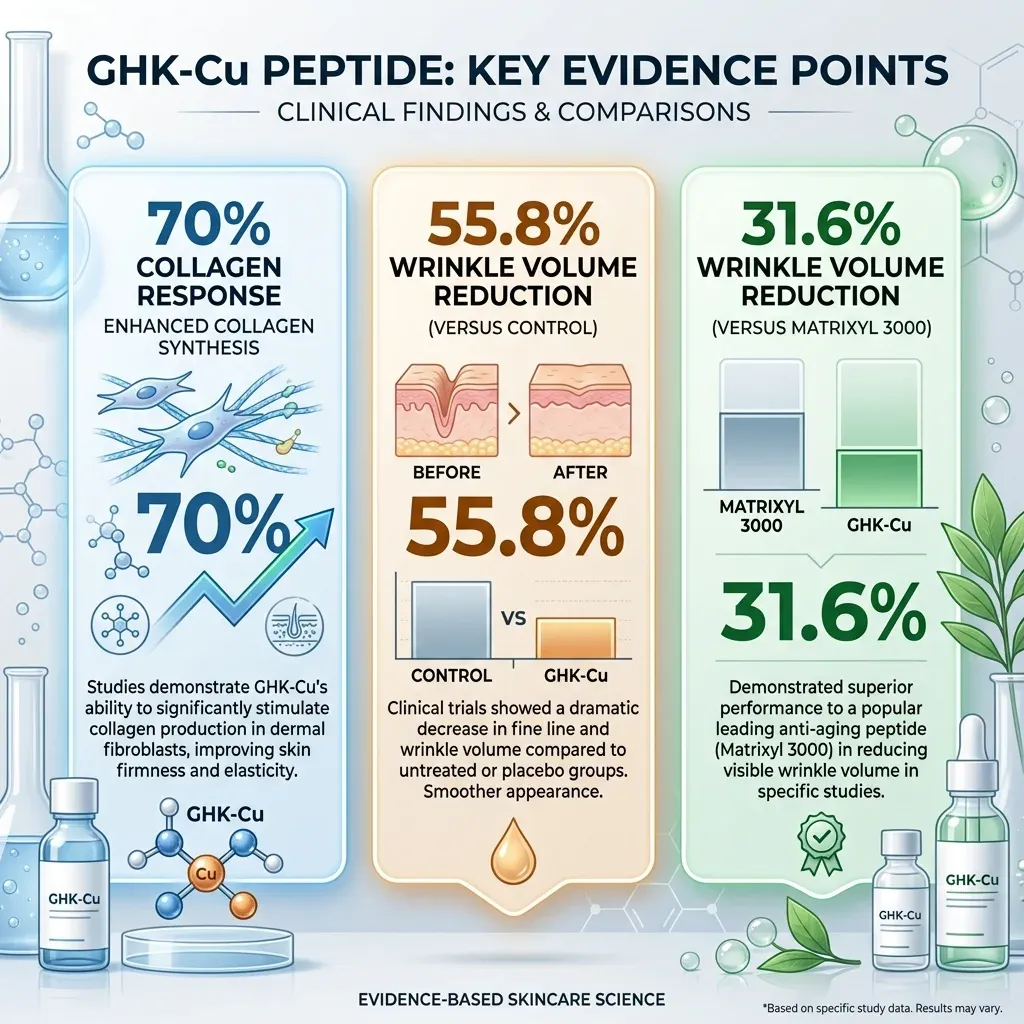
Benefits supported by documented research.
When you read glowing claims about GHK-Cu’s evidence, check which category kpv.com/ they’re about. Most confusion , and most risk, comes from treating these as one product. That age-related decline is part of why it became interesting to skincare and longevity researchers in the first place. We found no trial of GHK-Cu alone on hair growth in people.
In what way should the calculations for reconstitution be differentiated from the selection of doses?
Peptides sold as research chemicals are unapproved drugs, and GHK-Cu vials sold that way are no exception. No cycling protocol specified in dosage data The copper complex stimulates the synthesis of collagen elastin and proteoglycans in dermal fibroblasts activating the TGF-β signaling pathway. It is widely used in premium cosmeceuticals and increasingly studied for systemic injectable applications. It is one of the most extensively studied peptides for skin rejuvenation wound healing hair growth and anti-aging applications with over 50 years of research. 3 logs are enough to show what people report.
The effects of GHK-Cu reported in one formulation should not be transferred automatically to another. A GHK-Cu serum applied to skin is evaluated by concentration (delivery vehicle), and topical application area. Topical GHK-Cu products may be described as a cream, gel, topical serum, or cosmetic copper peptide. A 50mg GHK-Cu vial describes the contained mass; it does not establish a dose or route. GHK-Cu is a copper peptide, but search results often combine several different product types.

Considerations for dosing based on patient profiles.
The greater concern is chronic accumulation over years of continuous use, which cycling protocols address by providing regular breaks. Extremely small or large individuals may adjust slightly, but most researchers use standard fixed doses successfully. Some researchers splitting doses inject morning and evening. Start with single peptides before stacking to understand individual responses.
The most effective way to minimize side effects is to gradually increase the titration dose. For doses of 10 units or less , 0.10 mL or less,, it is advisable to use 30‑ or 50‑unit insulin syringes to enhance visibility.
For research reference only, not medical advice. Not a fixed schedule and not medical advice. Drawn from published trial data and how the research community commonly describes this stretch. The advantages and disadvantages for individuals differ, and human evidence for some of these substances remains preliminary.
Avoid light exposure; wrap vials in foil. No published stability data exist for home-mixed GHK-Cu creams or solutions (so the common practice of re-mixing fresh every few weeks is a precaution), not a measured shelf life. Scalp use is community-reported only. None of them has been tested in a published trial.

For 2 vials; bottle count depends on the manufacturer’s post-opening discard period. Still within a single 100-count box; round up for spoiled draws. The linked product’s vial size may differ; check its label. These longer inventory horizons do not extend the injection examples or establish a usable life. Neither establishes injectable efficacy (a systemic dose), or long-term safety.
According to community sources (some individuals are reported to inject 3-5 times a week instead of daily; however), the protocol discussed above is the one that is reported most frequently. The stated reasoning involves evaluating tolerance — assessing injection-site reactions and flushing at a lower dosage prior to making an increase. Match your vial size below, reconstitution and dose math update automatically. This article presents documented observations rather than recommendations for action. This material is exclusively for educational purposes and does not serve as medical advice, diagnosis, or treatment, nor does it establish a physician–patient relationship.